
The stock market has changed rapidly in the last decade. Two major forces are reshaping how markets work:
1. Algorithmic Trading – automated systems that make trading decisions.
2. Social Media Sentiment – collective mood and opinions expressed online.
Together, they are altering how prices move, how markets react, and how investors behave. This article explains how each factor works, how they interact, and what that means for today’s financial markets.
What Is Algorithmic Trading?
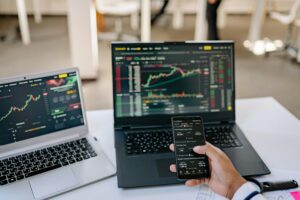
Algorithmic trading refers to the use of computer programs and pre-defined rules to execute trades automatically. These algorithms can analyze vast amounts of market data and place trades at speeds humans cannot match.
How It Works
Algorithms use mathematical models and data inputs such as price, volume, and volatility to make decisions. They can:
- Scan markets in real time.
- Trigger buy or sell orders within microseconds.
- Adjust strategies based on new information.
- Advanced systems also use machine learning and artificial intelligence (AI) to improve performance over time.
Growth and Scale
The use of algorithmic trading has risen sharply across global financial markets. It is no longer limited to large institutions alone. Algorithms continue to gain a larger share of daily trading volume because they offer speed, precision, and data-driven decision-making.
How Social Media Sentiment Influences Markets
Social media platforms like Twitter (X), Reddit, Facebook, and StockTwits have become places where investors share opinions and news. These platforms now influence how markets move and how traders make decisions.
What Is Social Media Sentiment?
Social media sentiment reflects the overall mood of online discussions—whether people feel positive, negative, or neutral about a stock or the market in general. Using natural language processing (NLP) and AI, sentiment analysis can measure the emotional tone of millions of posts.
Direct Impact on Trading
Studies have found that sentiment on social media can correlate with price movements and trading volume, especially when strong emotions are shared widely. Algorithms and human traders may use this sentiment data as a signal to:
- Buy when sentiment is strongly positive.
- Sell when sentiment turns negative.
- Adjust risk positions based on emerging trends.
Research has shown that sentiment scores derived from social media can be compared with stock indices and may help in predicting price changes.
Interaction Between Algorithmic Trading and Social Media Sentiment
Today’s trading systems are increasingly not just analyzing market prices but also social data.
Sentiment-Driven Algorithmic Strategies
Some trading algorithms now include sentiment analysis as an input. These systems scan social media posts in real time and interpret them using NLP models. When they detect changes in sentiment, they can trigger trades quickly—often before human traders react.
This integration of sentiment and high-speed trading is reshaping traditional strategies. Instead of relying only on historical price or technical indicators, algorithms now look at collective investor mood as a potential signal.
Case Examples
One type of approach studies sentiment from platforms like Reddit and extracts key mood indicators. These signals are combined with volume changes to make predictions about short-term stock returns. Research has shown sentiment-based strategies can outperform basic “buy and hold” approaches under certain conditions.
Benefits of This New Approach
The combination of algorithmic trading and sentiment analysis has several advantages:
Faster Market Reaction
Algorithms process data far faster than humans. They can react to sudden spikes in positive or negative sentiment before traditional traders can respond manually.
Improved Efficiency
Automated systems reduce human bias and emotion, which can lead to clearer decision-making, especially during volatile market conditions.
Enhanced Predictive Power
By including sentiment data, trading models may capture market expectations and psychological factors that traditional models might miss.
Challenges and Risks
Despite the benefits, there are risks too.
Over-reliance on Sentiment Signals
Sentiment is not always accurate. False or misleading posts can sway sentiment scores and lead to poor trading decisions. Social media sentiment can be noisy and contain spam or manipulative content.
Relying too heavily on sentiment can make algorithms trigger trades in response to hype rather than fundamentals.
Market Manipulation
Social media has occasionally been used to manipulate stock prices. For example, coordinated campaigns can pump up the price of a stock (even without real fundamentals). Although regulators work to detect and prevent manipulation, bots and fake accounts can still influence sentiment.
Flash Crashes
When algorithms respond too quickly to sentiment shifts or unusual patterns, they can amplify volatility. Rapid automated trading during brief spikes in sentiment can cause sudden price swings, sometimes called “flash crashes.”
Regulatory and Ethical Considerations
Regulators are increasingly watching how social media data is used in financial markets. The U.S. Securities and Exchange Commission (SEC) and other bodies have issued statements warning about the risks of relying solely on social media for investment decisions. Safeguards are needed to prevent abusive practices and protect market integrity.
The Future of Markets
Both algorithmic trading and social media sentiment analysis are set to grow. As data science and machine learning improve, algorithms will likely become more sophisticated in interpreting sentiment and integrating it with other data.
In the future:
- Sentiment analysis tools may become standard in trading platforms.
- Regulations may require clearer transparency around sentiment-related strategies.
- Investors will need to balance sentiment signals with fundamentals and risk management.
Conclusion
Algorithmic trading and social media sentiment are changing the dynamics of the stock market in profound ways. Together, they:
Make markets react more quickly to information.
Introduce new sources of data into trading decisions.
Increase both opportunities and risks for traders.
While these technologies offer powerful tools for understanding and anticipating market movements, they also require careful implementation and oversight. The future will likely see even deeper integration of technology and investor psychology in financial markets.